A Guide to the Safest Hockey Helmets
With all that we know about concussions, the most important piece of equipment for players is the hockey helmet. At Sports Etc., we like to highlight a few important pieces to focus on when choosing the best hockey helmet for safety. Most notably: proper fit, protection level, and lifespan.
Proper Fit
A proper fitting helmet should fit snugly on the player’s head. Any sign of a helmet rattling around, or fitting too loosely can be a major issue. Hockey players can take a variety of impacts, and a helmet that does not sit tightly on the head can lead to a variety of dangerous scenarios. Mainly, the helmet being dislodged from the player completely.
One of the commonly overlooked aspects of fitting a helmet is how the cage fits onto the helmet itself. Many helmets are sold in “combo” form, with a cage already attached, but it is important to know that sometimes cage size and helmet size are not always consistent with each other. That is why we recommend buying the cage and hockey helmet separately for the best concussion prevention. The cage should sit right on the player’s chin, and should be firmly locked into the “J-Clips” on the side of the helmet. This ensures that the cage will not be driven into the players chin upon impact, which is a common factor in concussions.
Protection Level
Hockey hits come in all types, sizes and intensities. Often times, it is not necessarily the biggest hit on the ice that causes injury, but the most “awkward” hits. Different types of protection levels are essential in preventing concussions. Most helmets on the market help to protect against linear or direct impacts to the head. The difference between the cheaper and more expensive (but safest) hockey helmets is the quality of the foam used within it. The best type of foam to look for is layered EPP or Poron. Most helmets in the $120+ range contain these materials. Low-end helmets often contain one layer of standard VN foam, which loses protective capability over time as it hardens.
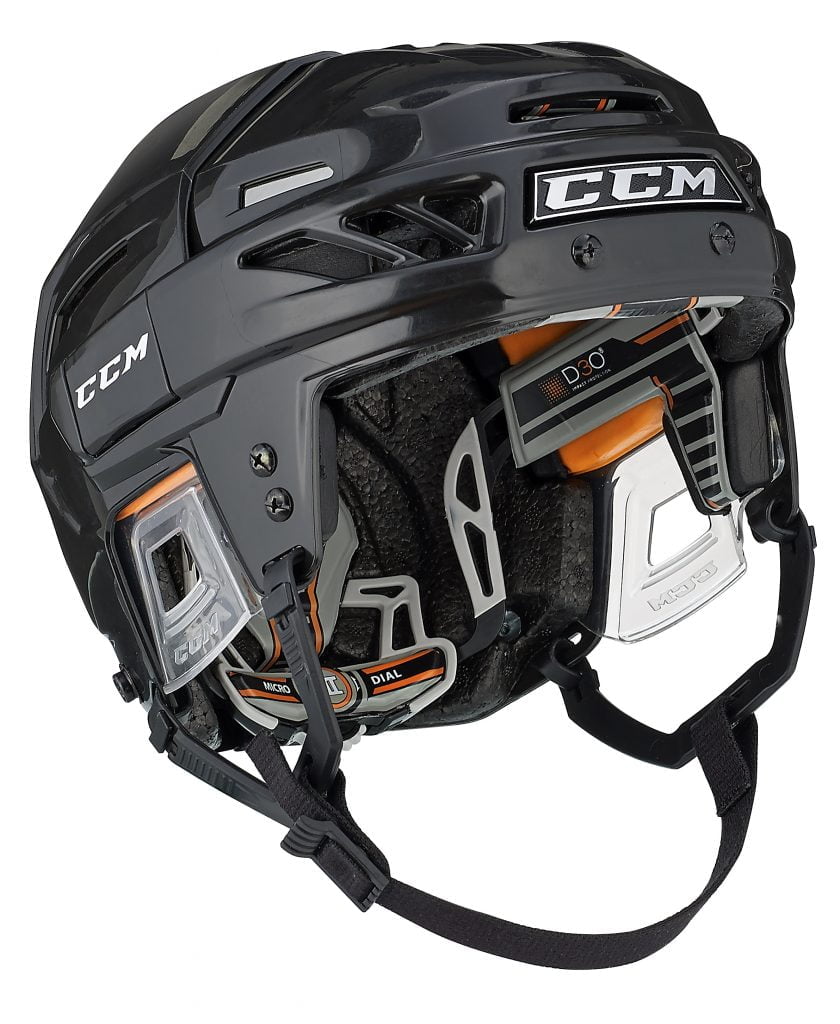
The one aspect that differentiates the BEST hockey helmets from lower-end versions is a helmet’s protection level against rotational impacts. Most helmets can withstand a linear or direct impact with sufficient protection for the player, but rotational impacts typically have a more devastating impact on a player’s head. There are numerous helmets on the market that take these safety ratings into account, most notably the Bauer Re-Akt series and the CCM 3DS series. These technologies help the head move independent of the helmet, so the awkward angle impacts—which cause the head to snap around with the helmet—are mitigated.
Lifespan
Another critical and overlooked area in preventing concussions is the lifespan of a helmet. Routinely, a player can wear the same size helmet for years and years. A lot of times, a youth hockey player can stay in that same size helmet until adulthood. Like most things, however, components of a helmet can get worn down over time. The important piece to look at is the foam within the helmet. The foam is designed to take repeated impacts, but over time as the impacts increase, and sweat is absorbed and dried out into the material, the foam hardens. When the player takes an impact, this hardened foam is driving into the head, which can cause major head trauma. Sports Etc. recommends changing out your helmet every 3 years, whether that means re-examining and repairing or replacing.
The Top 3 Most Protective Hockey Helmets That Sports Etc. Recommends:
CCM 3DS (Read More) $259.99
Bauer Re-Akt (Read More) $199.99
CCM FitLite (Read More) $199.99